Sharing your dog's ashes between the people who loved them
A dog's ashes weigh about 3-5% of body weight[1], which is usually far more than a few keepsakes need. List who wants what, and see exactly how the ashes divide and what stays in the main urn.
- Keepsakes, pendants, rings and tubes
- Shows what's left for the main urn
- Names optional, nothing saved

Ashes sharing planner
Plan who keeps what. We work in cubic inches, the unit urns and keepsakes are sold in (about 1 cu in per lb of body weight).
Left for the main urn
47 cu in (769 mL)
Out of about 50 cu in in total.
| Person | Keepsake | Ashes |
|---|---|---|
| Me | Keepsake urn | 3 cu in |
| Person 2 | Pendant | 0.05 cu in |
| Main urn | 47 cu in | |
A pendant holds about a pinch of ashes and a ring even less, so jewelry barely changes what's left. Scattering tubes vary a lot in size; check the one you choose.
Source: Embrace Pet Insurance - Bury or Cremate Your Dog? Costs, Pros & Cons; Our estimate. keepsake capacities are typical sizes, so check the product you choose
Next step: Ask a local provider to divide the ashes for you →
Using the planner
How to plan who keeps what
- Start with the total. Enter your dog's body weight, or type the ash volume directly if the crematory has told you.
- Add a row per person. Type a name if you like, choose an item and a quantity.
- Pick from four item types: a keepsake urn (about 3 cubic inches), a pendant (about 0.05), a ring (about 0.02) or a small scattering tube (about 10).
- Read the balance. The planner shows a table of how much each person takes, and the figure "Left for the main urn" in cubic inches and milliliters. If the wishes add up to more than there is, it says "Not enough ashes" instead.
It works in cubic inches because that's how urns and keepsakes are sold. The starting total uses the industry rule of about one cubic inch per pound of body weight, which gives figures like these:
12 cu in (cat); 70 cu in (dog)[4]
Example
Worked example: a 70 lb Labrador shared five ways
Imagine Duke, a 70 lb yellow Lab, leaving about 70 cubic inches of ashes. His family's wish list looks like this:
| Who | Item | Space used |
|---|---|---|
| Mom and Dad | Main urn (what remains) | about 51 cu in |
| Three grown children | 3 keepsake urns | 9 cu in |
| The same three, plus Grandma | 4 pendants | 0.2 cu in |
| Youngest daughter | 1 ring | 0.02 cu in |
| Everyone together | 1 scattering tube for the beach | 10 cu in |
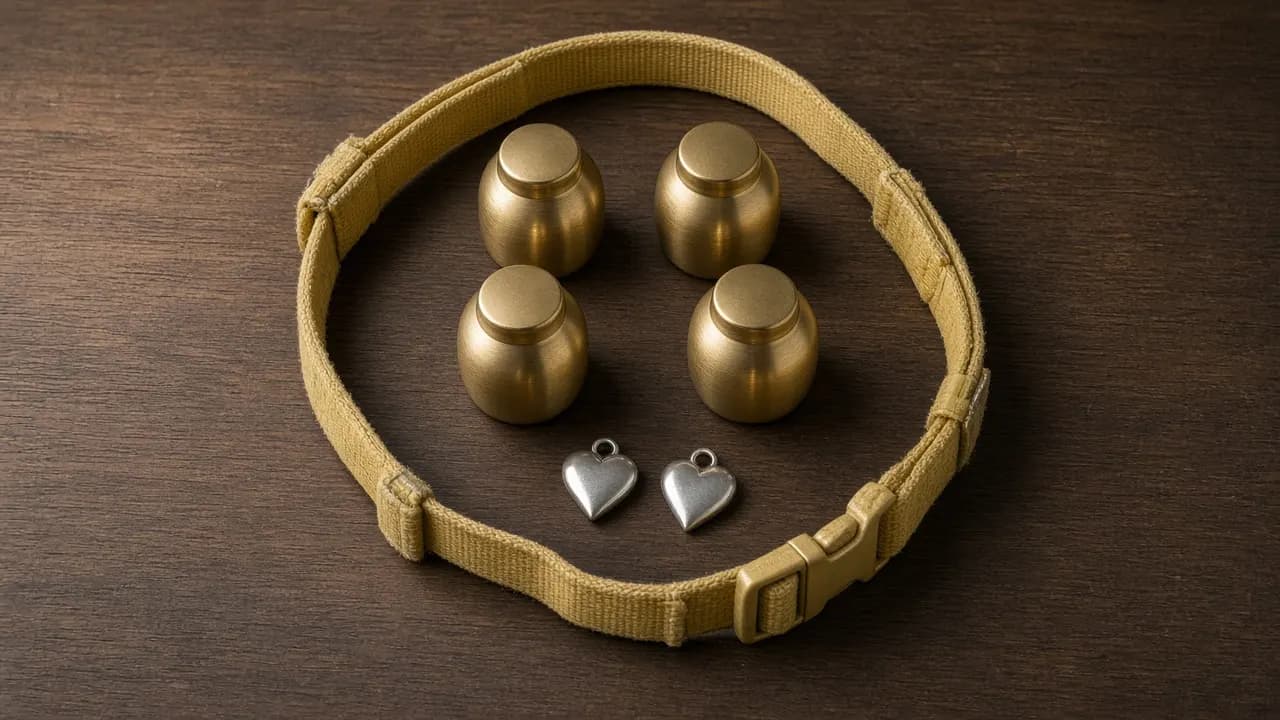
In the planner that's four rows (3 keepsake urns, 4 pendants, 1 ring, 1 small scattering tube), roughly 19 cubic inches shared out, leaving about 51 in the main urn, which fits a medium urn with room to spare. Notice how little the jewelry uses: Duke's ashes could fill well over a thousand pendants. Jewelry is almost never the constraint; keepsake urns and scattering are.
Doing it
How to divide the ashes in practice
You can ask the crematory to divide the ashes for you. Many will fill keepsake urns if you send them ahead, sometimes for a small fee, which saves you handling them at home. If you'd rather do it yourself, work over a tray, use a small funnel and a teaspoon, and fill jewelry with the tiny funnel that usually comes with it.
Talk about the plan before the cremation if you can. It avoids hurt feelings later, and it lets you ask for private cremation, which is the only way to be sure every portion is your dog's alone. Our guide to private vs communal cremation explains how to confirm that in writing.
What would you most want to keep from your dog?
Tap an answer to vote and see how others answered. Anonymous.
Worth knowing
Where the planner's numbers can be off
The capacities are typical, not universal. Some pendants hold twice what others do, and "keepsake urn" can mean anything from a thimble-sized heart to a tea-light holder. Check the stated capacity of each piece you buy. The total is also an estimate; a dog's actual ashes can come in a little above or below the rule, as the ashes weight estimator explains. The rule rests on how much of a body is bone mineral: a forensic study that weighed the remains from 100 human cremations found they averaged about 3.5% of adult body weight.
Small dogs change the picture. A 10 lb terrier leaves only around 10 cubic inches, so three keepsake urns would take almost all of it. For small dogs, jewelry and one main urn are often the kinder split. Giant breeds swing the other way: our estimate for a typical giant-breed dog is 3.8 lb[5] of ashes, enough for a keepsake for nearly everyone in a large extended family.
Next
Finishing the plan
Once you know what's left for the main urn, size it with the urn size calculator. For ideas beyond urns and pendants, like glass art or a planted tree, see our memorial ideas for dogs. And if the cremation isn't arranged yet, ask us for private options near you or compare services on our services page. Our guide to urn sizing and selection for dogs compares materials, and the local dog cremation pages show who offers private cremation where you live.
Free tool
Urn size calculator
Find the urn volume you need from your pet's weight, plus keepsake and sharing options.

Reader polls
What would you choose?
Vote anonymously and see how other readers answered. The results are live counts from people who visit this site, so they show real opinions, not a scientific sample.
What would you most want to keep from your dog?
Tap an answer to vote and see how others answered. Anonymous.
Do you keep more than one memorial for the same pet?
Tap an answer to vote and see how others answered. Anonymous.
Which memorial feels most like your pet?
Tap an answer to vote and see how others answered. Anonymous.

Free tools to help you plan
Ashes sharing planner
Split ashes fairly between family members, keepsake urns and jewelry.
Urn size calculator
Find the urn volume you need from your pet's weight, plus keepsake and sharing options.
Ashes weight estimator
See roughly how much ash to expect back, by species and body weight.
Questions people ask
Is it okay to split a dog's ashes between family members?
Yes. There's no rule against it, and many families do. It helps to agree the plan in advance so nobody feels left out, and to keep one main memorial if that matters to the household where the dog lived. Private cremation ensures every portion is your dog's alone.
How much ash goes in a cremation pendant?
Only a pinch, typically around 0.05 cubic inches, or less than a quarter of a teaspoon. Rings hold even less. That's why one medium or large dog can fill hundreds or even thousands of pieces, and jewelry rarely makes a noticeable dent in the main urn.
Can the crematory divide the ashes for us?
Many can, often for a small fee. Send or drop off the keepsake urns you've chosen and ask them to fill and seal them before returning everything. Jewelry is usually easier to fill yourself with the funnel that comes with it, or a jeweler can help.
How do we decide who keeps the main urn?
Most families keep it where the dog lived, with the person who did the daily care. If that's unclear, some choose a shared place instead, like scattering the main portion somewhere meaningful and giving everyone an equal keepsake. Talking it through before the cremation is much easier than afterwards.


Sources and our estimates
- [1] Embrace notes cremated remains typically weigh about 3-5% of the pet's original body weight. Embrace Pet Insurance - Bury or Cremate Your Dog? Costs, Pros & Cons, 2025.
- [2] In the RSPCA's pet-loss survey (over 4,000 respondents), 99.3% saw their pet as family, a friend or a companion. RSPCA — Pet Loss Survey Results, 2026.
- [3] Astute Analytica reports 51% of pet owners are interested in personalized memorials and 70% consider memorialization significant. Astute Analytica via GlobeNewswire — Global Pet Preservation Services Market to Hit USD 112.7 Million by 2032 (Apr 2, 2024), 2024.
- [4] Using the industry rule of thumb of 1 cubic inch of urn space per pound of body weight, a 12 lb cat needs an urn of about 12 cubic inches; a 70 lb dog needs about 70 cubic inches. Our estimate: urn cu in = body weight lb x 1 (industry rule of thumb, not a measured value). How we calculate.
- [5] A median-weight giant-breed dog (48.8 kg / 108 lb) would be expected to return about 1.71 kg (3.8 lb) of cremated remains, needing an urn of about 108 cubic inches. Our estimate: 48.8 kg x 3.5% x 2.2046 lb/kg; urn = 108 lb x 1 cu in/lb. How we calculate.
Arrange a private cremation first
Tell us what you need and where you are. We'll reply by email with clear options and prices so you can decide in your own time.